
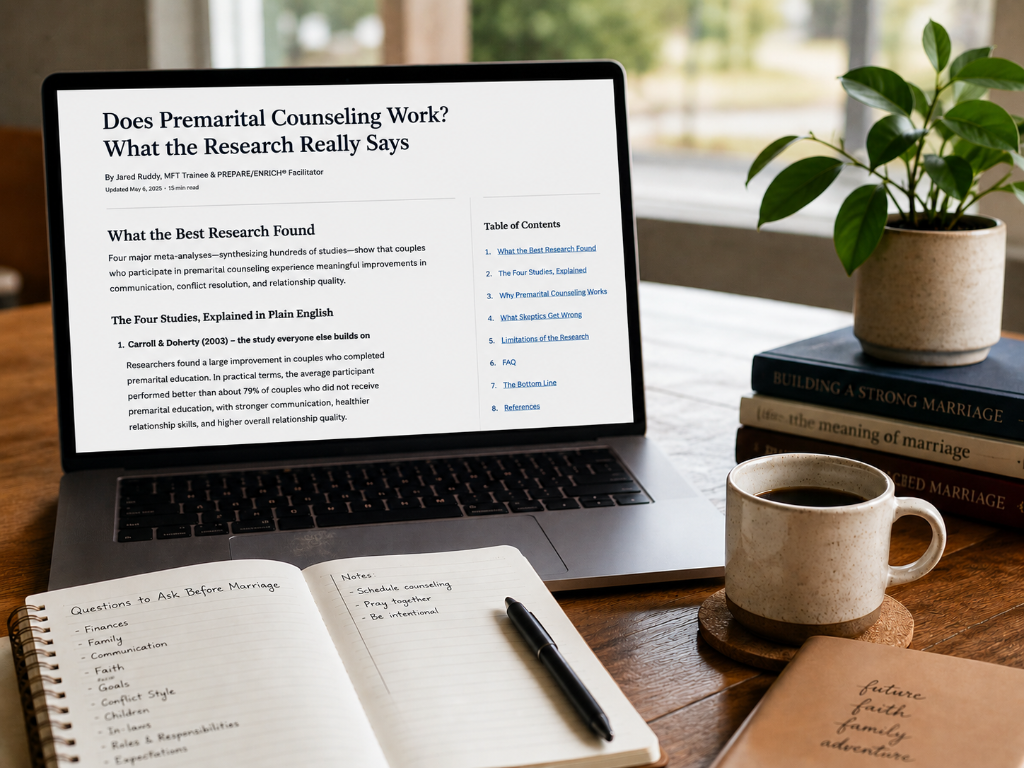
Does Premarital Counseling Work? What the Research Really Says
Four major meta-analyses — synthesizing hundreds of studies — show that couples who participate in premarital counseling experience meaningful improvements in communication, conflict resolution, and relationship quality.
You're planning a wedding, and somewhere between choosing a venue and tasting cake flavors, someone suggests premarital counseling. Maybe your officiant requires it. Maybe your mom keeps bringing it up. Either way, you're left wondering: is this actually going to help, or is it just one more box to check before the big day?
It's a fair question. Nobody wants to spend a Saturday afternoon in a counselor's office if it isn't going to make a real difference. So let's look at what the research actually says — not the marketing copy, not the Pinterest quote graphics, the actual peer-reviewed studies.
The short answer: yes, it works, but with real nuance. No program can guarantee a happy marriage. Nothing can. But a substantial body of research, built up over more than two decades by family psychologists, shows that couples who go through structured premarital counseling communicate better and, in several major studies, report meaningfully higher relationship quality than couples who skip it. The effects aren't uniform across every study — and a good researcher will tell you that — but the overall pattern holds up.
What the Best Research Found
If you only read one section of this article, read this one.
Four large meta-analyses — studies that pool the results of dozens of smaller studies to look for a consistent signal — form the backbone of what we know about premarital education. Together they represent thousands of couples and more than a decade of academic scrutiny. Here's the short version:
- Couples who complete premarital programs tend to do noticeably better than couples who don't — the average participant ends up better off than roughly 8 in 10 people who received no premarital education at all.
- The strongest, most consistent effects show up in communication skills — how couples listen, argue, and repair conflict — not just in how happy couples say they feel.
- Program "dosage" matters. A single afternoon workshop is not the same intervention as a multi-week program, and the research shows moderate-length programs outperform brief ones.
- The picture isn't perfectly clean. When researchers included unpublished studies — the ones that don't make it into journals, often because the results were less flattering — the boost to relationship satisfaction specifically became harder to detect, even though the communication benefits held up.
That last point matters, and we'll come back to it, because a genuinely honest answer to "does this work" has to include it. Overselling the research doesn't serve anyone — least of all the couples deciding whether to invest their time.
The Four Studies, Explained in Plain English
Academic papers are dense on purpose — precision matters more than readability when you're publishing in a peer-reviewed journal. But you shouldn't have to have a PhD to understand what they found. Here's each study broken down.
Carroll & Doherty (2003) — the study everyone else builds on
What they did: Published in Family Relations, this was the first major meta-analytic review of premarital prevention programs, pulling together the existing outcome research on the topic up to that point.
What they found: The average effect size across the pooled studies was d = .80 — a large effect by the standards of social science research. In plain terms, that means the average person who went through a premarital program ended up better off afterward than 79% of people who didn't participate. Stated as a percentage gain, participants saw roughly a 30% improvement in the outcomes researchers were measuring — things like communication and relationship quality.
Why it matters: This paper became the foundational citation for the field. It's the study that first gave researchers, therapists, and policymakers a credible, quantified answer to "does this actually do anything." Nearly every article, therapist website, and church program that cites premarital counseling statistics today is drawing, directly or indirectly, from this paper.
Hawkins, Blanchard, Baldwin & Fawcett (2008) — the big one
What they did: Published in the Journal of Consulting and Clinical Psychology — one of the most rigorous outlets in clinical psychology — this study went bigger and broader than Carroll & Doherty. The team searched for every codable study they could find and ended up analyzing 86 separate reports, yielding 117 individual studies and more than 500 effect sizes.
What they found: For relationship quality, the effect sizes in properly controlled (experimental) studies ranged from d = .30 to .36 — a moderate, meaningful effect. For communication skills specifically, the effects were larger: d = .43 to .45. The researchers also found that programs with a moderate amount of instructional time produced bigger gains than brief, low-dosage programs — in other words, a two-hour seminar isn't going to move the needle as much as a multi-session program will.
Why it matters: Because of its size and the rigor of the journal it appeared in, this is arguably the single most credible piece of evidence in the field. It confirms that the effect isn't a fluke of a few small studies — it holds up across more than a hundred independent evaluations, run by different researchers, on different programs, with different couples.
Blanchard, Hawkins, Baldwin & Fawcett (2009) — zooming in on communication
What they did: The same research team went back and focused specifically on communication skills — arguably the outcome that matters most for a long marriage, since research on marital longevity consistently points to how couples fight, not whether they fight, as the deciding factor. This analysis reviewed 97 research reports, representing 143 distinct evaluation studies.
What they found: Premarital and relationship education showed measurable, positive effects on communication — and interestingly, the effect worked in two directions. It helped healthy, well-functioning couples build even stronger skills over the long term (what researchers call "universal prevention"), and it helped couples already showing signs of strain in the shorter term ("selective prevention"). One notable finding: studies that used direct observation of couples' communication — trained raters watching couples interact, rather than couples simply filling out a survey about themselves — found larger effects than self-report studies. That's a meaningful detail, because it suggests the improvement isn't just couples feeling more optimistic after a workshop — it's showing up in how they actually behave with each other.
Why it matters: This is the study that most directly answers "does premarital counseling teach real skills, or does it just make people feel good temporarily?" The observational data suggests real, behavioral change — not just a mood boost.
Fawcett, Hawkins, Blanchard & Carroll (2010) — the necessary reality check
What they did: Also published in Family Relations, this study did something the earlier ones hadn't done as thoroughly: it deliberately went looking for unpublished research — dissertations, conference papers, and studies that never made it into a journal — alongside the published literature, coding a total of 47 studies. This matters because published research has a well-documented bias toward positive results; studies that don't find an effect are less likely to get published at all.
What they found: Here's where the picture gets more complicated, and more honest. When unpublished studies were folded in, the effect on relationship quality and satisfaction weakened and became statistically unreliable. The effect on communication skills held up, particularly in studies that used observational measures rather than self-report surveys — echoing the Blanchard (2009) findings.
Why it matters: This is the study responsible marriage researchers point to when they push back on oversold claims about premarital counseling. It doesn't say counseling doesn't work. It says the evidence for relationship satisfaction specifically is thinner than the evidence for communication skills, once you correct for publication bias — and that the field still has real room to improve how these programs are designed and evaluated. A good article on this topic should say that plainly instead of citing only the papers with the biggest numbers.
The Four Studies at a Glance
| Study | Year | Studies Pooled | Focus | Effect on Communication | Effect on Relationship Quality |
|---|---|---|---|---|---|
| Carroll & Doherty | 2003 | Existing outcome research | Overall premarital prevention | Large (d = .80 overall) | Large |
| Hawkins, Blanchard, Baldwin & Fawcett | 2008 | 117 studies / 500+ effect sizes | Marriage & relationship education | Moderate–large (d = .43–.45) | Moderate (d = .30–.36) |
| Blanchard, Hawkins, Baldwin & Fawcett | 2009 | 143 studies | Communication skills specifically | Positive (larger with observation) | Not the focus |
| Fawcett, Hawkins, Blanchard & Carroll | 2010 | 47 studies (incl. unpublished) | Reality check / publication bias | Held up (observational) | Weakened, unreliable |
So What Do You Actually Take Away From This?
Read across all four studies and a consistent, defensible picture emerges: premarital education reliably improves how couples communicate, and it produces a meaningful — if more variable — boost to relationship quality. The communication findings are the most rock-solid part of the research, replicated across methodologies, including studies that watched couples interact rather than just asking them how they felt. The satisfaction findings are real but somewhat less consistent once the file drawer of unpublished null results gets opened.
That's not a weaker story than the marketing blogs tell — it's a more credible one. And credibility is exactly what you want when you're deciding whether to spend your time and money on something before one of the biggest commitments of your life.
Why Premarital Counseling Actually Works: The Psychology Behind It
Most articles on this topic list the topics covered in premarital counseling — money, family, intimacy — and stop there. That tells you what's discussed, not why discussing it changes anything. The psychology behind the effect is more interesting than the topic list.
- It corrects mismatched expectations before they calcify. Most people don't walk into marriage with a shared, explicit understanding of what marriage will look like day to day — they walk in with an unspoken one, built out of their own family of origin, past relationships, and assumptions they've never had to say out loud. Counseling forces those assumptions into the open, while they're still easy to renegotiate. A mismatch discovered in year one of a relationship is a conversation. The same mismatch discovered in year eight, after it's shaped years of resentment, is a crisis.
- It builds communication as a trainable skill, not a personality trait. A lot of couples treat "we communicate well" or "we communicate badly" as a fixed fact about who they are. The research above suggests otherwise — communication behaviors are teachable and measurably change with structured practice, which is exactly what the observational studies picked up. Counseling gives couples a shared vocabulary and specific techniques (like structured listening or timeout-and-return conflict rules) that are hard to develop organically, under pressure, in the middle of an actual argument.
- It interrupts destructive conflict patterns while they're still small. Marital researchers, most famously John Gottman, have spent decades documenting how a small number of destructive interaction patterns — contempt, defensiveness, stonewalling, criticism — predict divorce with striking accuracy. Those patterns rarely start big. They start as small habits, formed early, that get more entrenched the longer they go unaddressed. Premarital counseling is, in effect, an early intervention — a chance to notice and interrupt a pattern before it's had years to harden.
- It creates emotional safety for hard conversations. A counselor's office is a low-stakes place to practice a high-stakes skill. Couples get to have their first real conversation about, say, whether they want kids, or how they'll handle a mother-in-law who overstays her welcome, in a room designed to keep that conversation from becoming a fight. That matters because emotional safety — the sense that disagreement won't threaten the relationship itself — is itself one of the strongest predictors of relationship stability in the broader psychological literature.
- It turns "someday" conversations into scheduled ones. Couples don't avoid hard topics because they don't care. They avoid them because there's rarely a natural moment to bring them up, and bringing one up unprompted can feel like starting a fight. Counseling manufactures the moment. It gives both partners permission — even an obligation — to have conversations that might otherwise get postponed for years.
- It builds relationship habits before old patterns get set. Habits are easier to build than to break. Couples who go through counseling before the wedding are laying down communication and conflict habits during a relatively low-stress window, rather than trying to retrofit new habits onto a relationship already strained by the pressures of children, mortgages, or a decade of accumulated small grievances.
What Skeptics Get Wrong About Premarital Counseling
Not everyone is convinced, and the skepticism usually isn't unreasonable — it's just missing a piece of context.
"We already communicate well." This is probably the most common objection, and it's worth taking seriously rather than dismissing. But the research on premarital education specifically includes well-functioning couples, not just distressed ones — Blanchard and colleagues (2009) found that MRE benefits couples with no current problems too, describing it as "universal prevention." Communicating well today, before you've navigated a shared mortgage, a difficult in-law, or a miscarriage, isn't the same as having tested communication skills under real strain. Counseling isn't remedial. It's closer to strength training for a skill you'll need to rely on heavily later.
"Counseling is only for struggling couples." This confuses premarital counseling with crisis therapy. Couples therapy typically treats an existing problem. Premarital counseling is preventive — closer to a pre-flight checklist than an emergency repair. The research bears this out directly: the same studies that show benefits for couples with early warning signs also show benefits for couples with no problems at all.
"We don't need someone telling us how to marry." No competent counselor tells a couple how to marry. A good premarital counselor doesn't hand down a script for the relationship — they surface questions the couple hasn't asked each other yet and provide structure for answering them. The content of the marriage is still entirely the couple's own.
"Isn't this just common sense?" Some of it is — and that's sort of the point. A lot of what protects marriages is common sense that almost nobody actually gets around to practicing without a nudge. Nobody disputes that flossing is common sense either, and dentists still see plenty of cavities. Structure and accountability are what turn "obvious advice" into "things people actually do." That's the entire mechanism behind why a scheduled, facilitated conversation outperforms the same conversation left to chance.
Not All Programs Are Created Equal
One nuance the research keeps surfacing: structured, evidence-based programs consistently outperform loosely guided chats or general advice. The Hawkins et al. (2008) findings on "dosage" back this up directly — programs with more substantive instructional time produced larger effects than brief, low-dosage sessions.
Programs like PREPARE/ENRICH use standardized relationship assessments to map a couple's specific strengths and growth areas, then build exercises around what actually shows up in their results, rather than working from a generic script. That personalization appears to be part of what drives stronger outcomes — the couple gets feedback based on their actual relationship, not a one-size-fits-all curriculum.
Communication Is the Common Thread
If there's one finding that shows up across nearly every major study, including the more cautious ones, it's this: communication skills are where premarital education delivers its most reliable, replicated results. That lines up with decades of separate research on long-term marriage, which has consistently found that healthy marriages aren't marriages without conflict — they're marriages where both people know how to fight fair, repair afterward, and stay emotionally connected while disagreeing.
That's a skill, and skills are easier to build in a low-stakes setting than to improvise under real pressure. Premarital counseling gives couples a place to practice before the years that test a relationship for real — careers, kids, aging parents, financial strain.
What Premarital Counseling Can't Do
It's worth being honest about the limits here, especially given what the Fawcett (2010) findings show. Premarital counseling is not insurance. It doesn't guarantee anything, and the research on relationship satisfaction specifically is more modest than some marketing claims suggest. Every marriage, even a well-prepared one, will go through hard seasons, disappointments, and periods of real strain.
What the research more confidently supports is a narrower, still meaningful claim: premarital counseling reliably builds communication skills, and it plausibly — though somewhat less consistently across the full body of evidence — improves relationship quality. It's preparation, not a guarantee. Athletes train before competition. Pilots run through checklists before takeoff. None of that eliminates risk entirely — it reduces it, and it builds the reflexes needed when things get hard.
How much a couple gets out of it seems to depend on three things: the quality and length of the program, whether both partners engage honestly rather than going through the motions, and whether they keep practicing the skills afterward rather than treating counseling as a box to check before the wedding.
Does Christian Premarital Counseling Work Differently?
For couples of faith, premarital counseling often does double duty. Beyond the evidence-based relationship skills — communication, conflict resolution, financial planning — a Christian approach folds in a theological understanding of marriage as a lifelong covenant, along with explicit conversations about forgiveness, sacrificial love, and shared spiritual practice.
The research doesn't isolate "Christian counseling" as a distinct category with its own effect size, but shared values and mutual commitment are well-established predictors of relationship strength in the broader literature. For couples grounding their marriage in shared faith, pairing that spiritual foundation with a structured, evidence-based curriculum tends to reinforce both — the practical skills and the deeper "why" behind the commitment. If that's the path you're considering, learn more about our online Christian premarital counseling program.
The Bottom Line
Two decades of peer-reviewed research, run by different teams, published in different journals, using different methods, keep landing in roughly the same place: couples who deliberately prepare for marriage build real skills they wouldn't have built on their own. The evidence for communication is about as strong as social science evidence gets. The evidence for relationship satisfaction is real but a little more textured, and any article that tells you otherwise is oversimplifying to make a cleaner headline.
None of that amounts to a guarantee — no study, no counselor, no book can offer one. What it amounts to is something more useful: good odds. A few hours spent now, while the relationship is calm and the stakes feel manageable, buy skills that are far harder to build later, under real pressure, with a lot more on the line. If the goal isn't just a beautiful wedding day but an actual, lasting marriage, that's about as good a bet as the research on human relationships is ever going to offer.
Research & References
- Carroll, J. S., & Doherty, W. J. (2003). Evaluating the Effectiveness of Premarital Prevention Programs: A Meta-Analytic Review of Outcome Research. Family Relations, 52(2), 105–118. Read on Wiley · Free full text (BYU)
- Hawkins, A. J., Blanchard, V. L., Baldwin, S. A., & Fawcett, E. B. (2008). Does Marriage and Relationship Education Work? A Meta-Analytic Study. Journal of Consulting and Clinical Psychology, 76(5), 723–734. Read on PubMed · Free full text (BYU)
- Blanchard, V. L., Hawkins, A. J., Baldwin, S. A., & Fawcett, E. B. (2009). Investigating the Effects of Marriage and Relationship Education on Couples' Communication Skills: A Meta-Analytic Study. Journal of Family Psychology, 23(2), 203–214. Read on PubMed · Free full text (BYU)
- Fawcett, E. B., Hawkins, A. J., Blanchard, V. L., & Carroll, J. S. (2010). Do Premarital Education Programs Really Work? A Meta-Analytic Study. Family Relations, 59(3), 232–239. Read on Wiley · Free full text (BYU)
- Gottman, J. M., & Gottman, J. S. (2015). 10 Principles for Doing Effective Couples Therapy. W. W. Norton & Company. Publisher page · Google Books
- Stanley, S. M., Rhoades, G. K., & Markman, H. J. (2006). Sliding Versus Deciding: Inertia and the Premarital Cohabitation Effect. Family Relations, 55(4), 499–509. Read on Wiley
- Olson, D. H., Larson, P. J., & Olson-Sigg, A. (2023). PREPARE/ENRICH Program: Research and Validation Report. PREPARE/ENRICH. Research page · Direct PDF
Four major meta-analyses — synthesizing hundreds of studies — show that couples who participate in premarital counseling experience meaningful improvements in communication, conflict resolution, and relationship quality.
Synthesis of Carroll & Doherty (2003), Hawkins et al. (2008), Blanchard et al. (2009), and Fawcett et al. (2010)
FAQ
Frequently Asked Questions
Does premarital counseling work?
Yes, with important nuance. Multiple large meta-analyses show it reliably improves communication skills, and most — though not all — show a meaningful boost to relationship quality. The communication findings are the most consistently replicated part of the research.
Is premarital counseling worth it?
For most couples, yes. A handful of sessions is a small investment relative to the years of marriage that follow, and the research shows real, measurable skill-building — particularly around communication and identifying mismatched expectations before the wedding rather than after it.
Does premarital counseling reduce divorce?
The research most directly and consistently supports improved communication and relationship quality rather than a precise divorce-reduction percentage. Divorce is difficult to study directly because it requires tracking couples over many years, and fewer studies have done that kind of long-term follow-up. What the strongest studies do show is that couples build durable skills — like healthier conflict patterns — that are independently associated with more stable marriages in the broader marital research literature.
How many sessions do couples need?
There's no single universal number, but the research is fairly clear that more substantive programs outperform brief ones — Hawkins et al. (2008) found moderate-dosage programs produced larger effects than low-dosage ones. Most structured programs run somewhere between four and eight sessions.
What happens during premarital counseling?
Sessions typically cover communication patterns, conflict resolution, financial expectations, family relationships, roles and responsibilities, intimacy, and long-term goals. Evidence-based programs like PREPARE/ENRICH also use standardized assessments to identify a specific couple's strengths and growth areas rather than working from a generic checklist.
Is Christian premarital counseling different?
It covers the same practical relationship skills as secular programs but adds a theological framework — treating marriage as a lifelong covenant and explicitly discussing forgiveness, sacrificial love, and shared spiritual practice alongside the communication and conflict-resolution work.